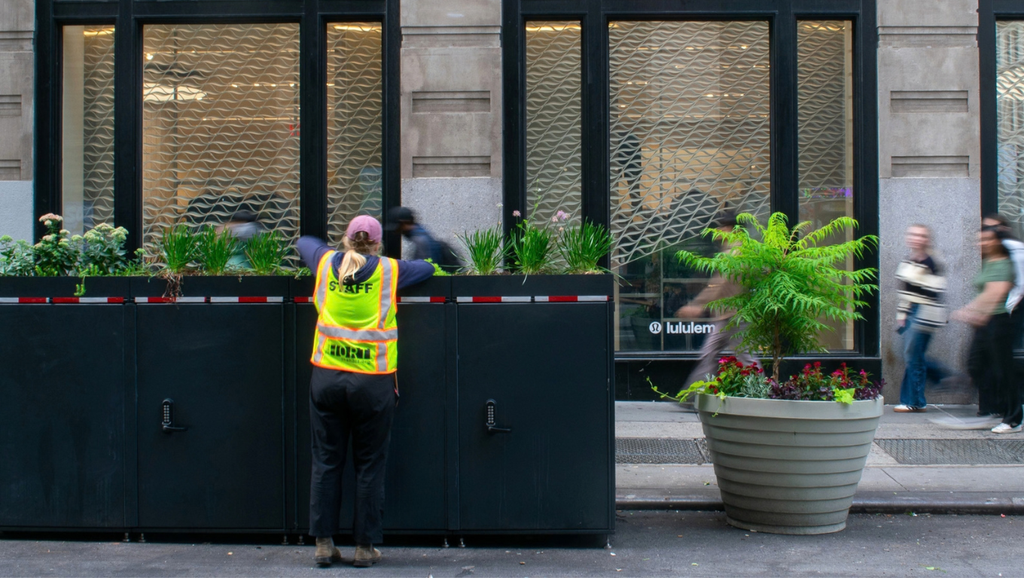
Greening SoHo’s New Trash Bins
SoHo, in Lower Manhattan, is known for its cast-iron buildings and busy shopping streets. The Broadway corridor alone draws more than 54,000 people a day, and its corners collect litter and trash bags waiting for pickup. Greenery is hard to add, too. Below many sidewalks, subway tunnels and utility lines leave little room for roots. As a result, the neighborhood has very few street trees. The SoHo Broadway Initiative, the neighborhood’s Business Improvement District (BID), … Greening SoHo’s New Trash Bins
Read MoreGiving Students A Chance To Grow
Many NYC students grow up with little hands-on access to plants and green space. Our educators find that 80 to 90% of new students have never planted anything. That holds true even in high school. The Hort has been working to change that since the 1980s. Take PS 206 José Celso Barbosa in East Harlem, which serves a large special education population. We’re in our tenth year there. The garden began as five rows of … Giving Students A Chance To Grow
From Trainee to Gardener
We’ve trained New Yorkers in horticulture for decades, but our workforce development program, HORTNYC, took its current form after the pandemic. During the city’s COVID cleanup hiring, we brought on around 100 staff for the New York City Cleanup Corps. We combined several older efforts, including a horticulture internship, reentry work connected to our program on Rikers Island, and therapeutic horticulture, to create our paid workforce development program. Trainees come to our program through referral … From Trainee to Gardener
Beating The Heat
Picture a planter in the middle of a heat wave: full sun overhead, hot pavement below, and no water source for blocks. By every rule of gardening, these are very challenging conditions. Yet our plantings hold their color through the hot NYC summer. So how do they make it through? Along with the dedication of our crew who work all year, in all conditions, The Hort has strategies to make our plantings heat-resilient. The most … Beating The Heat
Where Healthy Food Is Part Of The Care
We’re in our first year partnering with St. Barnabas Health & Wellness Center (SBH). SBH is located in Belmont, the central Bronx neighborhood most New Yorkers know as home to Arthur Avenue and the borough’s Little Italy. SBH is blocks away from one of the city’s great food destinations, yet fresh, affordable produce is hard to find. SBH built its wellness center to help people stay healthy enough that they do not need the hospital … Where Healthy Food Is Part Of The Care
Why Are Some Neighborhoods Hotter Than Others?
Every summer, New Yorkers brace for heat waves that test the limits of comfort, patience, and even urban infrastructure. What’s more, some neighborhoods feel noticeably hotter than others, sometimes as much as 12°F. This isn’t merely perception; it’s a measurable phenomenon known as the Urban Heat Island effect. In fact, urban areas in NYC can measure up to 7°F hotter compared to suburban surroundings due to surfaces like asphalt and concrete absorbing and radiating heat (ArcGIS … Why Are Some Neighborhoods Hotter Than Others?
Introducing the Carol Pino Learning Farm
All year long, The Hort has been quietly nurturing a project we can finally share: the Carol Pino Learning Farm, a two‑acre outdoor classroom in Bergen Beach, Brooklyn. When NYC Public Schools set out to transform an empty lot into a living laboratory, they asked The Hort to supply the planting and programming vision, as well as the maintenance roadmap. Building on horticulture design expertise and years of success in programming and operating the Greenhouse & Education Center (GEC) in Denny Farrell Riverbank State Park, The Hort … Introducing the Carol Pino Learning Farm
From Harlem to All Corners of NYC
Earlier this year, the Greenhouse and Education Center at Denny Farrell Riverbank State Park looked like a quiet, dormant shell of its vibrant summer self. What had once been lush and flourishing had died back, pruned and tucked in for the winter. But beneath this stillness and throughout the RENEW winter season, something powerful was already taking root. From February through April, our staff, interns, and community members began the work of seeding hundreds of … From Harlem to All Corners of NYC
Meet Our Watering Truck Operator!
Last month, we explored the challenges of watering plantings throughout NYC, a task that’s not for the faint of heart. At The Hort, we take pride in our extensive plantings across 60 sites throughout all five boroughs—that’s hundreds of beds and planters, all needing regular watering. To meet the needs of our widely dispersed plantings, we rely on a mobile solution—our watering trucks. These two trucks provide thousands of gallons of water every week to keep … Meet Our Watering Truck Operator!
8 Reasons Why Watering in NYC is Incredibly Hard
Water. Like the air we breathe, water is essential to human survival. Similarly, plants are dependent on water, but they are unable to access it without help. In fact, one of the most challenging aspects of creating green spaces in New York City is making sure plants have the water they need to survive. In the next two newsletters, we will explore how water, the simplest of things, can be complex in highly urban environments. … 8 Reasons Why Watering in NYC is Incredibly Hard
Transforming Hellstrips Into Urban Oases by Jeremy Jungels
Introducing Jeremy Jungels, our Senior Director of Horticulture at The Hort. He has been with The Hort for 5 years, but prior to that, he interned at several botanic gardens, ran his own landscaping business in central NY, and did plant and wildlife research in New York and New Mexico. Besides geeking out on plants, he likes to stay active with hiking, dance, and sports. In bustling urban landscapes, the narrow strips of land between … Transforming Hellstrips Into Urban Oases by Jeremy Jungels