Every summer, New Yorkers brace for heat waves that test the limits of comfort, patience, and even urban infrastructure. What’s more, some neighborhoods feel noticeably hotter than others, sometimes as much as 12°F. This isn’t merely perception; it’s a measurable phenomenon known as the Urban Heat Island effect. In fact, urban areas in NYC can measure up to 7°F hotter compared to suburban surroundings due to surfaces like asphalt and concrete absorbing and radiating heat (ArcGIS StoryMaps, 2024).
The Urban Heat Island effect is closely linked to the physical structure of our city. Concrete sidewalks, asphalt roads, densely packed buildings, and minimal vegetation trap and radiate heat, intensifying temperatures day and night. Neighborhoods with fewer trees and less greenery, often due to dense urban planning and infrastructure challenges, experience significantly higher temperatures. These heat islands aren’t randomly distributed—they often disproportionately impact low-income neighborhoods, highlighting deep inequalities within New York City’s urban landscape. Studies confirm these communities have significantly less tree canopy, leading to greater vulnerability to heat (Nature Conservancy NYC Canopy Facts, 2023)
The challenge may seem daunting but the solution is straightforward and The Hort addresses it every day by creating gardens and green spaces within the urban grid. Introducing vegetation into urban spaces is one of the most effective ways to combat heat islands.
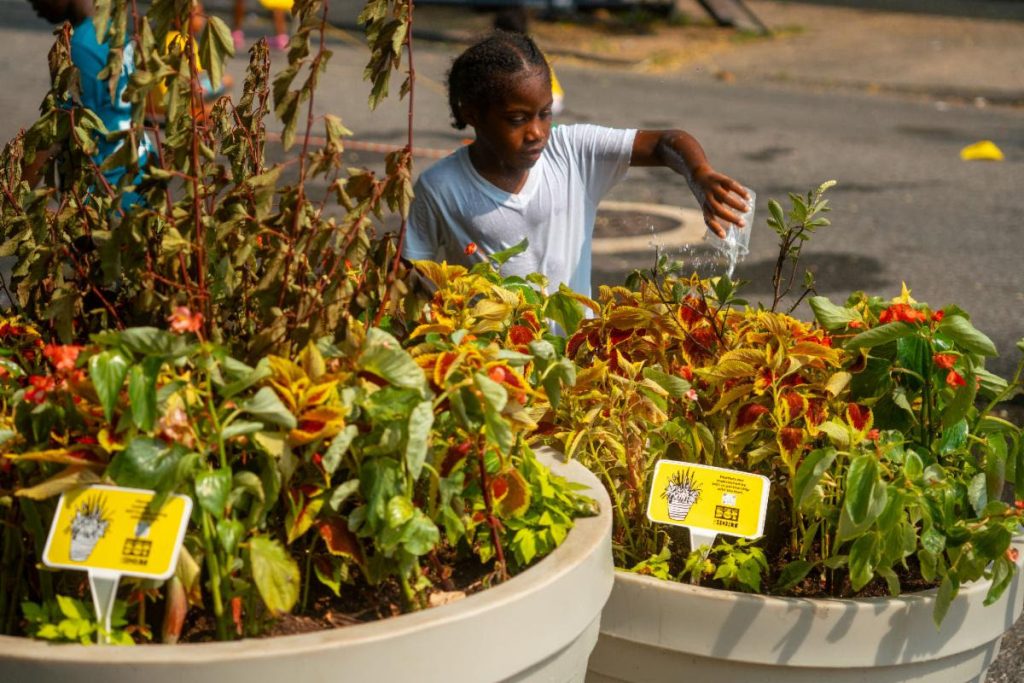
At The Hort, we’ve committed ourselves to making these green transformations a reality across New York City. We reclaim small spaces—even traffic medians and sidewalks—and nurture them into vibrant green pockets, that directly counteract the Urban Heat Island effect. Small-scale plantings are more than aesthetic enhancements; they serve as vital cooling stations capable of lowering neighborhood temperatures, improving air quality, and providing residents with welcoming spaces for rest, interaction, and relief from intense heat.
A prime example of our recent work is in the heart of Manhattan in Chelsea, where there is a great need for trees due to building heights and lack of greenery. In collaboration with Council Member Erik Bottcher’s office, we installed five beautiful new trees. The specific block chosen has historically been devoid of trees due to underlying subway infrastructure and adjacency to a Con Edison Transfer Station, both of which prevent traditional planting.
Our innovative solution was both straightforward and impactful: we placed five extra-large planters along the sidewalk, each housing a robust, drought-tolerant tree. Council Member Bottcher highlighted the significance of these plantings, stating, “The trees we’re planting today will benefit our neighborhoods for decades to come—filtering air pollution, absorbing stormwater runoff, providing cooling shade, supporting local wildlife, and making our streets more beautiful and welcoming.”
Every community, especially those hardest hit by heat, can benefit from horticultural interventions. Each additional tree, rain garden, or planter contributes incrementally to a broader, sustainable cooling network. Block by block, The Hort demonstrates that even small pockets of greenery can significantly impact community wellbeing.
Want The Hort to help bring more plants to a public space near you to combat the Urban Heat Island effect? Visit our website to learn more about how we work.